

FY25 HUD Continuum of Care Notice of Funding Opportunity (NOFO)
A preliminary court ruling has blocked the FY25 NOFO. Under the ruling, the U.S. Department of Housing and Urban Development has returned to year two of what was supposed to be a two-year grant cycle all along, for FY24-25. Unless there is another change, this means that current grants will be renewed for a second year, and a competitive process will return for FY26. Read more below.
Continuum of Care grants expected to continue a second year; competition expected in FY26
The status remains uncertain for the FY25 Continuum of Care grant opportunity. In response to a preliminary court ruling, the U.S. Department of Housing and Urban Development announced that if the ruling becomes final, it will return to year two of what was supposed to be a two-year grant cycle all along.
That means if the ruling holds, we anticipate the current local projects will be funded for a second year and that the next grant cycle will be competitive.
Current Continuum of Care grantees with projected FY25 grant amounts.
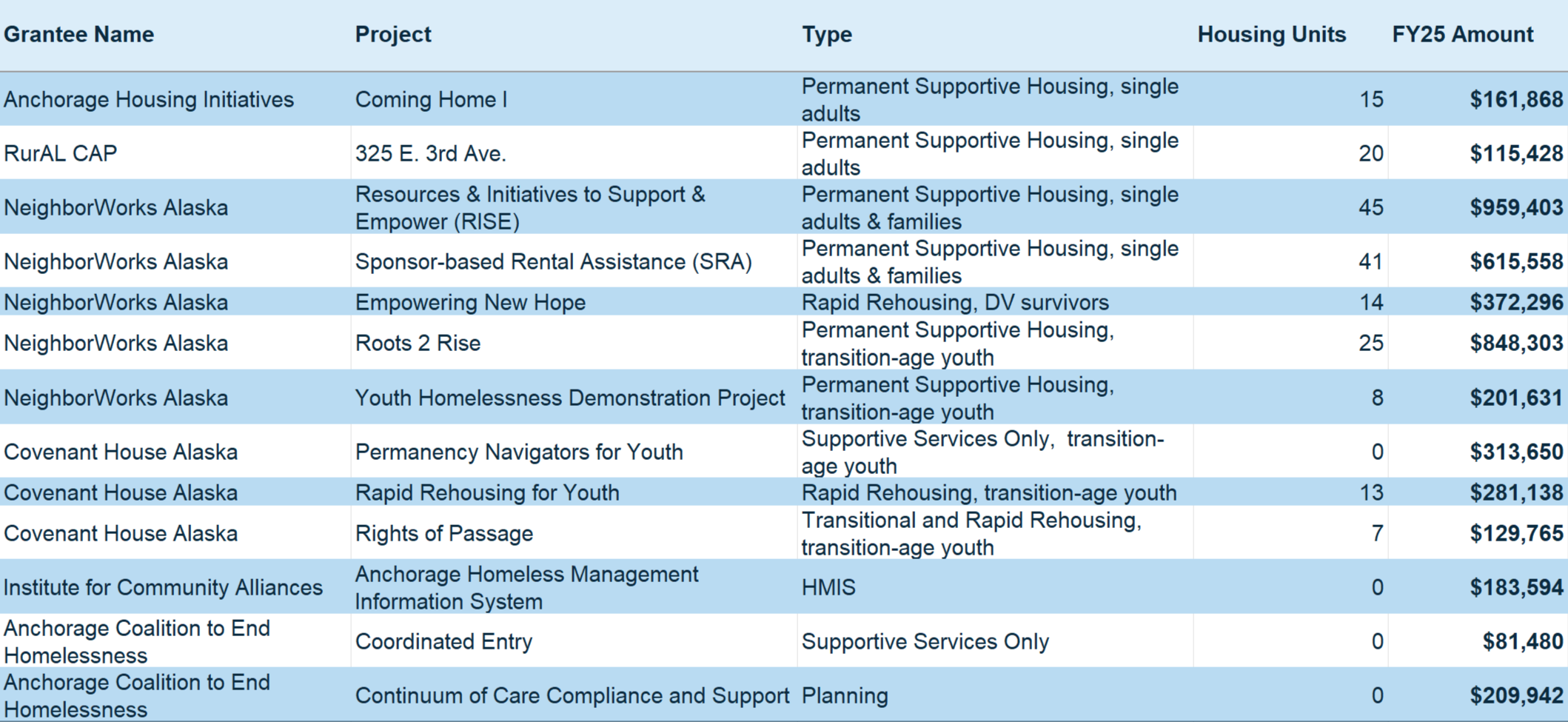
In its response to the Dec. 23 federal injunction, HUD has specified that if it becomes final, FY24 local grantees that want to renew their projects will not be required to reapply for FY25 funds unless the local Continuum of Care chooses to reallocate dollars. All Anchorage projects funded for FY24 want to be renewed, and none of the money is being reallocated. In Anchorage, these grants help to pay for permanent housing, permanency navigators, data management and management of the Coordinated Entry program housing needs assessment program.
Current Anchorage Continuum of Care grantees are: Anchorage Housing Initiatives, RurAL CAP, NeighborWorks Alaska, Covenant House Alaska, Institute for Community Alliances and the Anchorage Coalition to End Homelessness.
This Continuum of Care grant opportunity has taken a few twists and turns. HUD originally sought to make more of the funds competitive and to redirect grants away from permanent housing and into transitional housing and supports by changing from a two-year NOFO to a one-year NOFO with new criteria. Advocates feared that as many as 170,000 people around the country would be displaced and could end up homeless and took their concerns to court. The preliminary court ruling blocked HUD from canceling the FY24/FY25 two-year grant opportunity and from two iterations of a new FY25 Notice of Funding Opportunity that could result in housing instability. The court case is on-going.
The CoC program is the nation's largest source of federal funding for homelessness assistance. These dollars support some 87% of permanent housing for those emerging from homelessness.
The Anchorage Coalition to End Homelessness is the HUD-designated lead agency for the Continuum of Care. One of our roles is to guide and support the CoC grant process.
We anticipate a return to a competitive grant process in FY26 that will provide opportunity for new grantees. We will keep our community informed.
Court halts new grant process and offers stability for Continuum of Care grantees
On Tuesday, Dec. 23, the U.S. District Court of Rhode Island issued a written order in favor of those raising concerns about the timing of and numerous changes in the FY25 CoC NOFO from the U.S. Department of Housing and Urban Development. The preliminary ruling is not a final order, but says that those bringing court challenges "have established a strong likelihood of success on the merits."
The order by U.S. District Judge Mary McElroy addresses many of the issues in pending lawsuits and most notably orders HUD to take steps necessary for eligible renewal grants as laid out in the FY24-25 NOFO that HUD earlier rescinded. The judge, preserving the status quo, put a hold on that rescission and ordered HUD to file a report by Dec. 30 that specifies necessary steps to process renewal grants as well as a timeline. That FY24-25 NOFO was intended to cover two years of funding.
The order also puts a hold on HUD's FY25 NOFO and specifies that the funding conditions being challenged cannot be enforced at this time.
The Anchorage Continuum of Care will share an update soon after the Dec. 30 deadline for a report from HUD.
Response to HUD’s 12/8 statement
As you likely have seen, HUD has decided to rescind the FFY 2025 CoC NOFO to make appropriate revisions. They have stated an intent to re-issue this NOFO with no timeframe other than "well in advance of the deadline for obligation of available Fiscal Year 2025 funds," which is 9/30/2026. As we know, it takes some time to process the applications, release award notifications, and for local field offices to issue grant awards.
ACEH is monitoring communications from HUD, as well as tracking the progress of the two lawsuits currently filed regarding this NOFO. We will be maintaining the previously communicated timeline and deadlines for the CoC local competition. We recognize this is a tight timeline with deadlines in the near future, but we anticipate most changes in this NOFO will remain in a re-issued NOFO and we want to maintain a strong application in the event the re-issued NOFO has the same or slightly extended deadlines previously communicated. Thank you for all of your hard work on project applications as well as your input into the collaborative (community) application.
Statement from HUD (12/8/2025) and link to statement below:
"The Department has withdrawn a Notice of Funding Opportunity (NOFO) with respect to the Continuum of Care (CoC) grant program. This withdrawal will allow the Department to make appropriate revisions to the NOFO, and the Department intends to do so. In the previous FY 24-25 NOFO, the Department reserved the right to make changes to the NOFO instead of processing renewals for a variety of reasons, including to accommodate a new CoC or Youth Homelessness Demonstration Program (YHDP) priority or new funding source. The Department still intends to exercise this discretion and make changes to the previously issued CoC NOFO to account for new priorities. HUD anticipates reissuing a modified NOFO well in advance of the deadline for obligation of available Fiscal Year 2025 funds."
Continuum of Care Program | HUD.gov / U.S. Department of Housing and Urban Development (HUD)